
The continued impact of the Legal Aid, Sentencing and Punishment of Offenders Act 2012, which resulted in the removal of eligibility for legal aid for the majority of private law cases in April 2013, has been laid bare by research from the Nuffield Family Justice Observatory (NFJO) which shows in 80% of cases at least one person is unrepresented.
Using data published by the Ministry of Justice, the NFJO says the long-term impact of LASPO is a substantial rise litigants in person. The number of cases where neither applicant nor respondent has legal representation has risen from from 13% in 2013, to 39% in 2024 after restrictions in access to legal aid in private family law means there is limited funding for issues concerning domestic abuse or child abuse, in addition to stringent financial means testing.
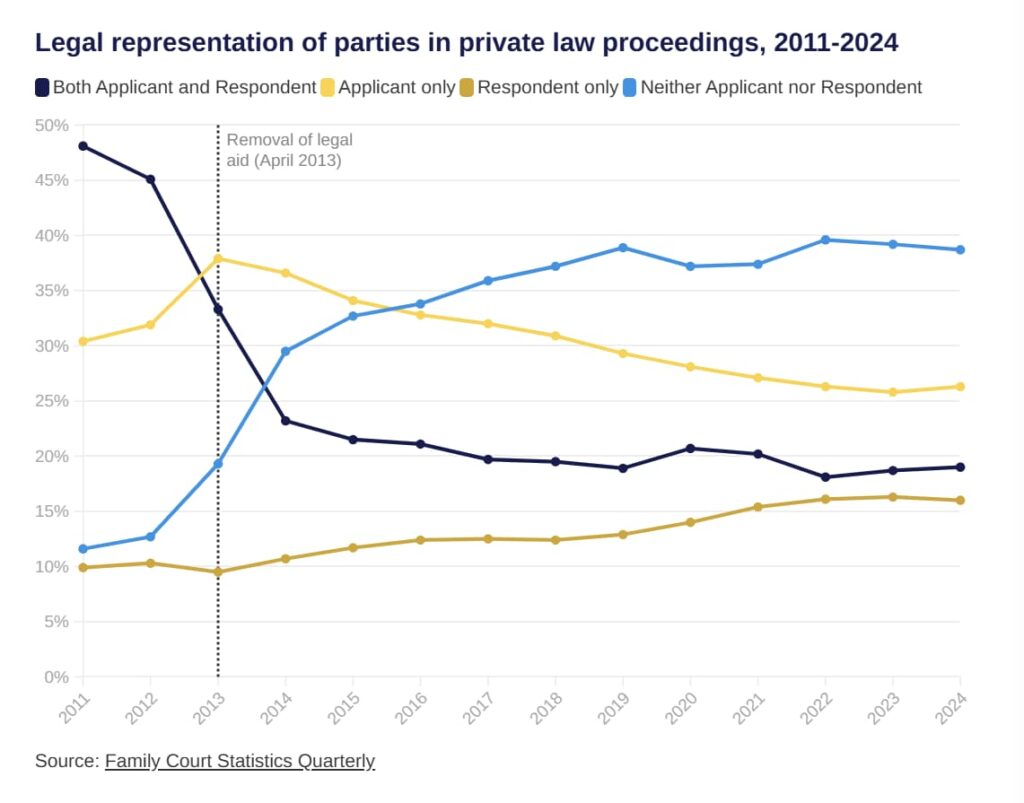
The statistics show representation for both applicant and respondent has fallen sharply since 2011 when in 28% of cases both parties were represented, to 19% in 2024.
This rise has had knock-on effects says NFJO, increasing pressures on the family courts as more applicants become litigants in person and require greater supports to navigate proceedings, as well as on other services such as community services or children’s social care when families struggle to resolve disagreements.
Access to Legal Aid has also been significantly hampered by the cyber attack in April 2025 which shut down many of the online systems and forced firms to work with little to no funding for long periods. The new ‘Signing into Legal Aid Services’ (SILAS) portal has now been launched with Crime Applications the first service back online. A restoration of services for Civil systems (Civil Apply, and the Client and Cost Management System (CCMS)), and services relating to the Controlled Work Administration (CWA) will follow in October say the Legal Aid Agency.