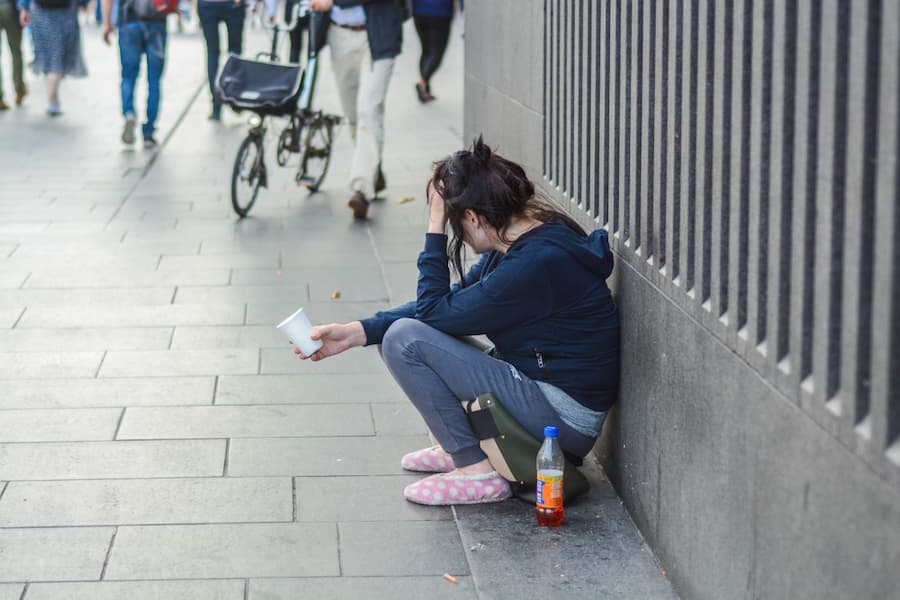

Homelessness as a result of cohabiting relationships breaking down is on the rise, according to a review of local authority applications where ‘relationship breakdown’ was recorded as a primary cause.
The latest statistics published by the Office for National Statistics (ONS) suggest there are 3.5 million cohabiting-couple families in 2025 (17.6% of all families); an increase of 17% (from 3.2 million) in 2015 and a 144% increase between 1996 and 2021.
The research from Rayden Solicitors, who sent Freedom of Information requests to 197 councils and received responses from 91 local authorities in England and Wales, points to a sizeable increase in homelessness caused by the breakdown of cohabiting relationships.
The North West ranks as the area with the highest number of applications across England and Wales, with a total of 17,504 over the last five years. Wales ranked second with 15,780 applications, followed by the South West (9,390) and London (8,795). The West Midlands (4030), East of England (3551) and West Yorkshire (961) ranked among the lowest.
Kayleigh Biswas-Gregory, senior associate at Rayden Solicitors, said the figures highlight a “wider housing risk that many couples face when relationships end” due to the “common misconception that unmarried couples have the same financial rights against each other on the breakdown of the relationship as married or civil partnered couples do”.
Regions with the most homelessness applications due to relationship breakdown (2020-2025)
| Region | Total applications |
| North West | 17,504 |
| Wales | 15,780 |
| South West | 9,390 |
| London | 8,795 |
| South East | 8,766 |
| Yorkshire and the Humber | 5,989 |
| North East | 5,786 |
| East Midlands | 5,179 |
| West Midlands | 4,030 |
| East of England | 3,551 |
| West Yorkshire | 961 |
The East of England has seen the largest increase in homelessness applications due to relationship breakdown over the last five years, increasing by 185% from 260 to 742. Overall, 3,551 applications were recorded during this period assessed. This was followed by the South East (up 59%), South West (25%), and London (20%), with the capital recording a total of 8,795 applications across five years.
Regions with the largest increase in homelessness applications (2020–2025)
| Region | Percentage change |
| East of England | 185.38% |
| South East | 59.44% |
| South West | 25.26% |
| London | 20.86% |
| West Yorkshire | 17.51% |
Lehna Gardiner, partner at Rayden Solicitors, said: “Under the current law, cohabitees have limited rights compared to those who are married. When married couples divorce, they have significant legal protection within the family law framework. The parties’ and children’s needs are prioritised and the principles of equality and fairness are applied. If a spouse were to pass away, then the living spouse has automatic rights to inheritance, pension and insurance, among others.
“For cohabiting couples, these principles unfortunately do not apply. This specifically leaves the financially weaker party in a vulnerable position in the event of a break-up. Often, these are women who have focused less on their careers in order to look after children. Cohabiting couples cannot rely on the family law framework and have no financial responsibility to one another on separation.”