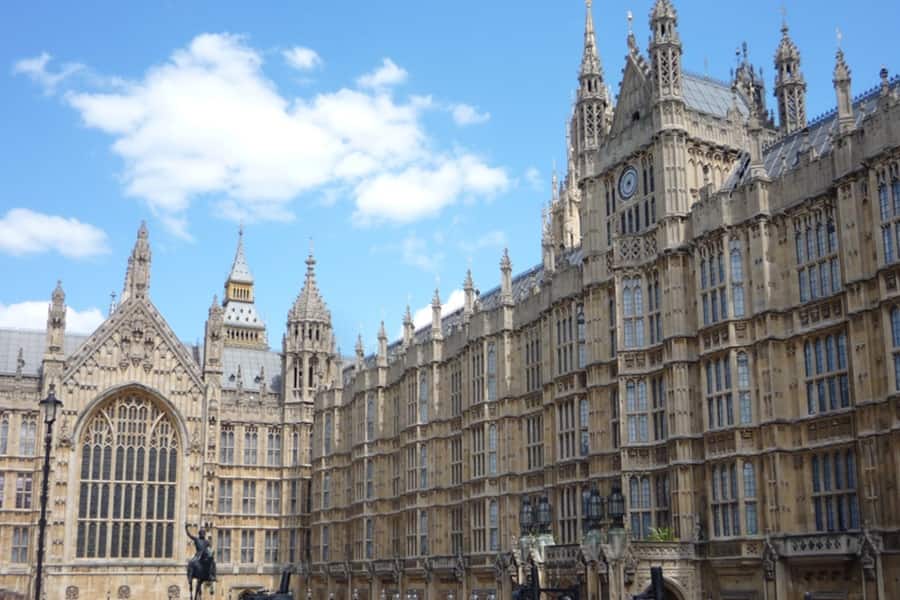
The government has said it “is not in a position to bring forward legislation on surrogacy reform” but will consider “options for future reform” following a debate in Parliament triggered by a public petition.
The House of Commons debate considered whether surrogacy laws in England and Wales should change to recognise parents of a child born by surrogacy at the time of the birth.
It followed a petition signed by 113,000 people calling for intended parents to become the legal parents of the child from birth, rather than having to go through a parental order process which can take months and can potentially leave a child in “legal limbo”.
Adam Frisby created the petition almost two years after he and his partner, Jamie Corbett, welcomed their baby daughter, Leven, via surrogacy in the US.
Following the debate, the minister for health, Diana Johnson, pointed out that under the Human Fertilisation and Embryology Act 2008, the person who gives birth to the child – in this case, the surrogate – is the legal mother when the child is born and has parental responsibility until the courts put in place a parental order.
Johnson said: “I am grateful for the opportunity to reflect on this area of law. The UK was, of course, one of the first countries to introduce a legislative framework for domestic surrogacy. The government supports surrogacy as part of a range of assisted conception options and recognises the important part it can play in supporting people seeking to start a family. In the Surrogacy Arrangements Act, Parliament decided that altruistic surrogacy arrangements would be legally allowed and that surrogates would be entitled to reasonable expenses. The Act was introduced to prevent surrogacy arrangements from taking place on a commercial basis.”
Johnson ruled out speeding up reforms, but said the government “hears loud and clear the need for legislative change”.
The parliamentary debate considered the practical legal difficulties for parents of children born via surrogacy, both in the UK and abroad, as well as ramifications of any changes to the legislation on the rights of the child or the woman who gave birth to them, as well as on adoptive and foster parents more broadly.
The petition highlighted that under current law intended parents must go through a months-long process in the courts and be visited by a social worker before they are considered to be the parents of the children in the eyes of the law.
Introducing the debate, Dave Robertson, Labour MP for Lichfield, said: “Ahead of this debate, I met the petition’s creator, Adam, his fiancé, Jamie, and their daughter, Leven, who was born via surrogacy in Connecticut. I am pleased to say that Adam and Jamie have joined us in the public gallery today. Although baby Leven has not joined them, she made a cameo appearance on our call ahead of the debate. Adam and Jamie are listed as Leven’s parents on her birth certificate in the United States, but more than six months after her birth, they still are not recognised as her legal parents at home in the UK.”
Jim Shannon, DUP MP for Strangford, said: “There are also very practical hurdles, such as registering the child with a GP, the child’s medical circumstances and applying for a passport. The whole thing is illogical. The practicalities add to the timescale, and it is time that the government address the issue.”
Josh Newbury, Labour MP for Cannock Chase, said: “We now have a situation where almost 1,000 children were born through surrogacy in 2025 – roughly double the number a decade earlier. For families who choose surrogacy, the journey to having a child has often already been extraordinarily long. So once that child is born and is being cared for by their intended parents, it is reasonable to ask whether the law should leave their legal parenthood unresolved for months.”
The debate considered the difficulties of the parental order process, which Robertson described as “really complex”. He pointed out that the document that intended parents have to submit is 200 pages long, with costs of legal advice potentially running into thousands. He also said the most distressing part of the process for most intended parents was the court-mandated social worker visit.
The Children and Family Court Advisory and Support Service (CAFCASS) is involved in surrogacy cases, with assessments for a parental order involving criminal checks, child protection reports, home visits with parents and a full, detailed report.
“Although it is incredibly rare to see CAFCASS reports on intended parents that are anything but wholly positive, parents find it extremely distressing to be questioned and scrutinised in a way that parents conceiving without the need for a surrogate simply do not experience,” Robertson said.
In 2018, the Conservative government asked the Law Commission for England and Wales and the Scottish Law Commission to jointly consider reforms to UK surrogacy law. When its report was published in 2023, it recommended: “A new pathway to legal parenthood in surrogacy cases, with the screening of intended parents taking place before birth, so that they could be recognised as legal parents from birth.”
The proposed pre-birth arrangements included an agreement between the surrogate and the intended parents, with independent legal advice provided to all parties, a preconception assessment of the child’s welfare, and the agreement of a regulated surrogacy organisation to recognise the surrogacy agreement. If the surrogate then withdrew consent, the existing parental order process would apply. If the surrogate changed their mind before the birth, they would be the legal parent at birth. If they changed their mind in the six weeks following birth, they would be able to apply for a parental order.
Jessica Brown-Fuller, Liberal Democrat MP for Chichester, said: “It is worth putting on record that the Law Commission report in 2023 suggested that, if everything was decided before the birth, the legal parents could have the rights from day one, but the biological, or surrogate, mother would have a chance to go against that in the first six weeks of the baby’s life.”
There was significant opposition during the debate to the proposals made in the petition. Rebecca Smith, shadow minister for education, said: “The petitioners frame the parental order process as an obstacle to parental rights, but that is fundamentally misleading. The legal process provides important protections for surrogate women and the children they carry.”
The majority of parental orders for UK parents now involve commercial surrogacy abroad, Smith pointed out, adding: “It should concern us all that international surrogacy takes place in jurisdictions where the economic circumstances of surrogate mothers are very different from those in Britain. If wealthy countries normalise the commissioning of pregnancies, there will inevitably be markets that meet that demand. In most cases, the women with the least economic power become the people expected to take the greatest physical risks.”
“The parental order process exists to ensure that a child’s welfare comes first and that a surrogate mother’s consent is freely given. Any reform should strengthen those protections for women and children, not diminish them.”
Tracy Gilbert, Labour MP for Edinburgh North and Leith, welcomed the opportunity to debate the topic but also took issue with “its framing” via the petition and highlighted the commercial implications of surrogacy.
She said: “There is likely to be an economic imbalance between the surrogate mother and the intended – commissioning – parents: by definition, they are commissioning a child. At present, the expenses paid to surrogates far exceed what was anticipated when the 1985 Act was passed. Although the Law Commission’s proposals claim to provide clarity on expenses, they could still result in commissioning parents paying tens of thousands of pounds to a surrogate, including payments for holidays and gifts. That economic power imbalance prompts the question: is it ever a free choice for a surrogate to enter into a surrogacy agreement?”
Commenting on estimates that the international surrogacy industry will be worth more than $200 billion by 2032, Gilbert said: “The decisions that we take about surrogacy in the UK can help protect vulnerable women and girls in war-torn countries such as Ukraine, and low-income countries such as Nigeria from being forced, coerced and trafficked to service the growing demand.”
Shannon also added his “significant concerns about the increasing commercialisation” of surrogacy, while Shivani Raja, Conservative MP for Leicester East, said: “Automatically recognising intended parents as legal parents from birth could remove important safeguards at precisely the moment when a child is most vulnerable.”
Steve Yemm, Labour MP for Mansfield, warned against “weakening safeguards” around surrogacy, but agreed the current legal systems were too slow. He said: “We should think carefully before weakening the safeguards in our law. If parental orders take too long, let us consider making them quicker, and if intended parents face practical difficulties, let us try to address them. We can make the system work better without changing the principle at its heart.”
There was a consensus that the current laws, however, don’t reflect the reality of modern families in the UK.
Rachel Taylor, Labour MP for North Warwickshire and Bedford, said: “Families have changed and society has changed; the law must now change too. That is why the Law Commission’s proposals are so important. They set out a new pathway through which intended parents could be recognised as legal parents from birth, rather than waiting for months to obtain a parental order.”
Amid a discussion over whether it was possible to speed up the process of a parental order for surrogates, Smith warned of the impact on adoptive and foster children. She said: “There have been a couple of mentions of the time it takes to get an order, but parents in the UK adoption system have equally long – often much longer – waits to take on parental rights over a child. We are in danger of creating two separate systems, so that putting in an order for a child through a surrogate is a quick option to become a parent, but we are making it harder for people who have gone through the care system to foster or adopt, or who have gone through a long adoption process. I wonder whether we are inadvertently suggesting that there should be a two-tier system.”
Jonathan Hinder, Labour MP for Pendle and Clitheroe, said: “However good the intentions of those bringing forward this petition for affected parents are, and I do not question them, any loosening of the surrogacy Laws would be a serious mistake. The text of the petition says that the current law is “outdated” because the woman giving birth to the child is recognised as the legal mother ‘even with no biological connection or intention to parent the child.’ Just think about how cold and clinical those words are: ‘no biological connection’, when that woman carried that child in their body and brought that child into this world. That is the commodification of women’s bodies.”
He added: “The petition asks the law to privilege an arrangement made before pregnancy and birth over the women who actually give birth, many of whom go on to deeply regret their role as a surrogate mother.” However, when asked to provide data for this comment, Hinder could not.
Neil Shastri-Hurst, Conservative MP for Solihull West and Shirley, agreed: “Compassion for intended parents cannot require Parliament to treat the woman who gives birth as a temporary party to somebody else’s story, nor should this be presented as a contest between traditional and modern families. Recognising different kinds of family does not require us to reduce the rights of the woman who carries the child. If the Government are considering recognising intended parents from birth, I ask the Minister to set out what protection would remain for a surrogate mother who changed her mind after giving birth.”
In the UK, commercial arrangements for surrogacy are prohibited, yet intended parents can travel overseas to access these arrangements. Yamm asked if this is “ a morally coherent position, and whether we should be looking at the rights of UK citizens to exploit commercial surrogacy overseas”. Shastri-Hurst, who is shadow undersecretary for health and social care, replied: “There is a clear inconsistency in prohibiting the practice here, while allowing such arrangements to be made abroad.”
Robertson remarked on the “quite stark divisions on the issue, which is understandably very emotive for a large number of people”, but said: “What seems clear is that the current law on surrogacy is no longer working and that a wider conversation about how we should change the legislation in this area would be welcome.”
Johnson clarified the government’s position on the topic. “I hear loud and clear the calls for legislative change this afternoon but, given the limited parliamentary time available, the government is not in a position to bring forward legislation on surrogacy reform immediately. We will, however, continue to consider options for future reform, and we remain engaged with the issues raised by stakeholders, parliamentarians and families with lived experience of surrogacy,” she said.
Robertson concluded the debate by saying: “It was clear today that this is an incredibly complex and detailed debate, and one that needs to be considered fully. While I am sure the petitioners would have preferred to hear a further update from the minister, she was very clear when she outlined the current legal position and advice from the government on surrogacy and that the government is staying exactly where they are and will get to this when time allows.”
Alexander Breedon, partner in the Family Team at Withers LLP, told Today’s Family Lawyer: “There are significant problems with the current law on surrogacy, and the Law Commission has already recommended a new pathway in their 2023 report, one which would allow intended parents to become legal parents from birth via regulated non-profit surrogacy organisations.
“This would ease the journey to legally recognised parenthood and help to provide clarity. A better and clearer system is needed not only to protect children (for example to avoid them being left ‘stateless’ and legally ‘parentless’) and intended parents, but crucially to protect and support potential surrogates.”