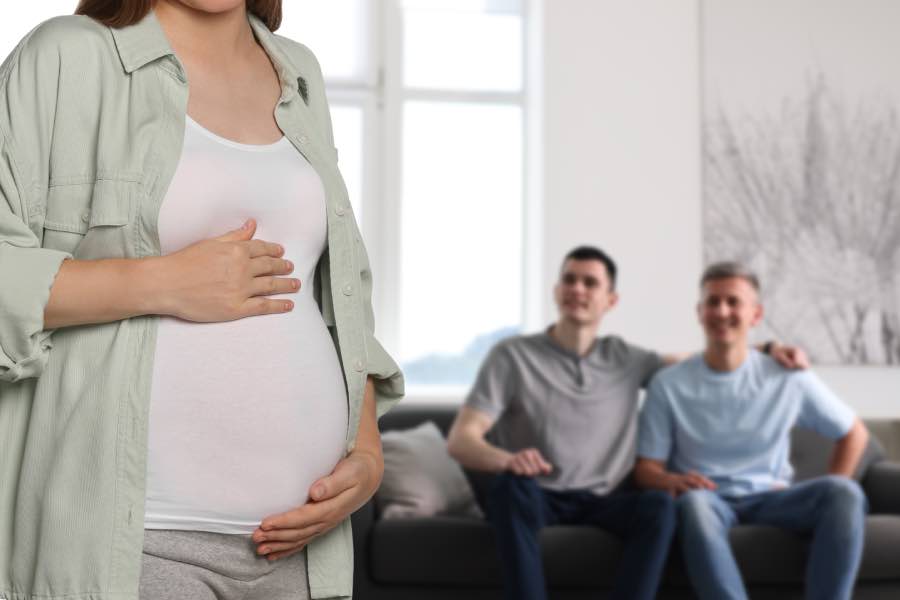

A petition to change surrogacy law to recognise intended parents from birth will be debated in parliament after hitting the threshold for signatures.
The petition, which calls for families who have children via a surrogate “not to have to go through months of court proceedings and social worker visits to be recognised as the parents of a child they planned and love”, reached over 10,000 signatures in 16 days after being published by Adam Frisby in April and will be debated on 7th September.
Responding to the petition in May, the Department of Health and Social Care said it supported surrogacy as a part of assisted conception options, and recognised the important part it can play in supporting people to start a family.
“We recognise that surrogacy is a complex and sensitive policy issue, where detail matters to all those involved in a surrogacy arrangement, in particular the important issue of legal parenthood,” the department said in a statement. “We know that surrogacy is a crucial route to family formation for many LGBTQ+ people, particularly male same-sex couples, and that the current pathway and delay to legal parenthood can cause uncertainty.
“Legal parenthood at birth rests with the surrogate (and their spouse/partner, if applicable). The intended parent(s) must apply to the court for a parental order after birth to become the child’s legal parents, under the Human Fertilisation and Embryology Acts 1990 and 2008. This framework applies equally to heterosexual couples, same‑sex couples, and single intended parents.
“The Department of Health and Social Care supported a multi-year joint project of the Law Commission for England and Wales and the Scottish Law Commission to review the current surrogacy laws. The Law Commissions consulted widely on this topic, which generated a wide diversity of views, and we welcome their comprehensive report.
“The government does not intend to put forward the Law Commissions’ legislative proposals at this time, owing to the limited time available to introduce new legislation. We will publish a government response as time and capacity allows and will look to consider this issue in the future.”
The petition was created almost two years after Frisby and his husband, Jamie Corbett, welcomed their baby daughter, Leven, via surrogacy in the US.
When they returned to the UK, the couple found that their child’s surrogate, Krista, was her legal parent under British law despite both fathers being named on their daughter’s birth certificate in the US, and there being no genetic relationship between Leven and the woman who gave birth to her.
“When our daughter was born through surrogacy, we became dads the moment we held her,” Frisby and Corbett said.
“But under current law, the surrogate is automatically recognised as the legal mother (and if she is married, her spouse is recorded as the legal father) even with no biological connection or intention to parent the child. Intended parents must then go through a lengthy court process to become their child’s legal parents. In 2026 we believe this is outdated. The law needs to recognise intended parents from birth.”
Sarah Dodds, senior associate in the family team at Birketts LLP, said: “It’s very encouraging to see that Adam Frisby and Jamie Corbett’s campaign for change has resulted in UK surrogacy laws being debated in parliament on 7th September. While there is still a long way to go, those with lived experience of surrogacy and professionals working in the field are hopeful that this debate can help drive sensible, pragmatic reform that benefits children and families alike.”