
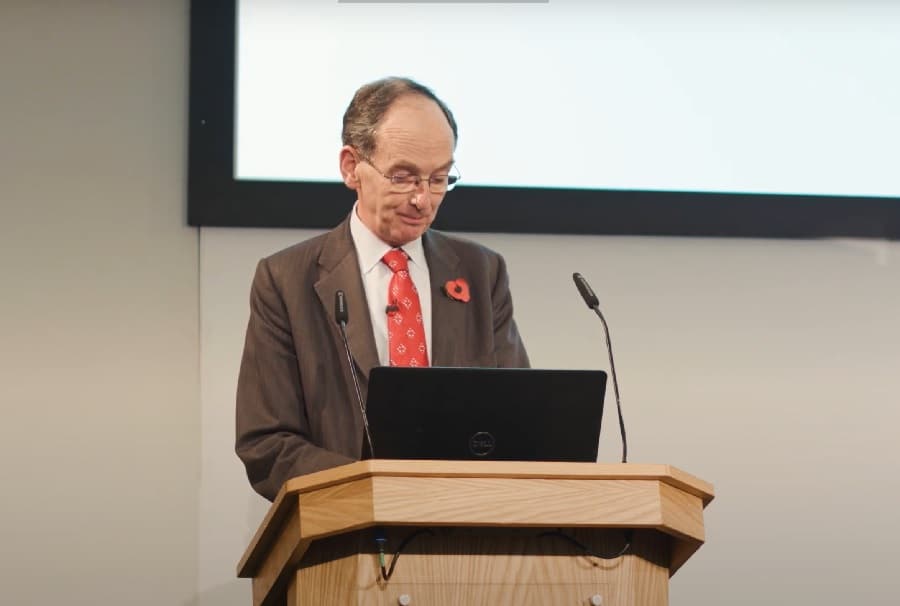

President of the family division Sir Andrew McFarlane has indicated he will step down once he has served a six month notice period with a successor likely to be in place before the end of that period.
The president make his comments at a parliamentary justice committee meeting on reform in the family courts this week. In a wide ranging discussion, Sir Andrew McFarlane was questioned on court delays, legal aid, judicial resources and the success of pilots like the Drug and Alcohol Courts and Pathfinder programmes.
On court delays McFarlane said public law cases had been hit hard by cuts to social care funding which left options for social workers to ‘do anything else but come to court… reduced.’ He highlighted the impact of COVID-19 compounded the issue and since 2022 the courts system has been working through the backlogs. With private law cases the lack of funding for legal aid means many people simply don’t see a solicitor who might discourage them from going to court he said, adding
“I think the perception in the public may have been that the lawyers were generating the work but I think the statistics show it was the other way around.”
McFarlane said the judiciary has been hit with shortages, particularly in the South East where he estimated a 20% shortfall in the number of district judges needed; and recruitment for more simply plundered from circuit judges so the shortages were just being passed downstream rather than recruiting to the level needed.
Quizzed on early intervention in family courts, McFarlane lamented the lack of funding for family hubs, Separating Parent Information Programmes, and mediation. He said there were plenty of ideas and proposals following the consultation resulting in ‘Supporting Earlier Resolution of Private Family Law Arrangements’ published in 2024 but they needed money.
“The new government, the previous Lord Chancellor, was in favour of what had been happening and some of them are progressing. In particular, the web presence is being funded because it is likely to be of great benefit, and it may well be used in other areas of the law. The Mediation Voucher Scheme carries on, and there is interest in doing more, but that is the list, that is what is needed. The feel that those of us in the court have is that there are a lot of cases that need to come. The domestic abuse cases need to come, but a lot of people come because it is the first port of call.”
He added he had anecdotal evidence that professionals have ‘no awareness of mediation or the Voucher Scheme or a SPIP or MIAM, and so I think that there is a feel out there that if you have got a problem with your ex, you go to court, and that is a major impediment to us being able to move forward because going to court does not help.’
There is a similar funding issue in Drug and Alcohol Courts, a postcode lottery said McFarlane, where there is evidence for every pound spend, the return is two or three pounds benefit, but the funding for psychiatrists, psychologists, specialists, addiction social workers is ‘not cheap.’ They are not part of the courts system and therefore the cost lands on the local authority in most cases. Police commissioners pay in some areas said McFarlane, and charities sometimes contribute, but for the mostpart funding is ‘haphazard.’
“It is not actually an MOJ problem” McFarlane told the committee. “The MOJ do their bit by providing the courtroom and the judge to be the facility, but the Home Office must have interest in this, Department of Health, Department of Education…”
In confirming his retirement Sir Andrew McFarlane, who tool on the role from Sir James Munby who served from 2012 to 2018, reflected on his tenure saying he had anticipated the rollout of the digital programme in family law to be completed ‘within three years’ of his appointment but was nearly now complete. He told the committee he considered his efforts to create greater transparency in the courts process a ‘prominent’ part of his time in office.
“You will know that we have opened up the court, and it is now part of business as usual that journalists can come in and can report what goes on without naming anybody. But being transparent is much more than simply letting a journalist in, it is an attitude of mind, being open. So I have been prepared to go on the radio, give interviews to journalists in a way that judges probably have not before, because I think the public have a right to understand what we are doing on their behalf.
“I think being transparent will carry on and will carry on being something that will need to be looked at… We were called the Secret Family Justice System or the Secret Family Court, and I do not think that can be applied to us now. We do not want to be, and I think that change has been a big one in my time.”

















3 responses
This is exactly the issue we built whatwouldajudgesay.com to solve.
Sir Andrew is absolutely right — far too many families head straight to court because they simply don’t know there are faster, calmer routes to a decision. When court becomes the first step rather than the last, everything takes longer, costs more, and becomes more painful for everyone involved.
Early clarity is the missing piece. When people understand what a judge is likely to say at the end of the process, they can reach agreement long before litigation spirals.
Thank you for reporting this so clearly. Families need this message now, not years into a court battle.
Oh my is all . Simply lost for words. Thank you for your service in these very difficult times
Is the President of family law devision any. plans to ’round up’ historic child abuse cases where organised criminal gangs prolifically abused many children in cases dating back to 1997 onwards in various boundaries Northamptonshire /Manchester & Liverpool to name a few .
Thank you to the President of Family Law Devision , Circuit Judges and Personell involved in the judicinal service in the persuit of transparency and above all
Justice for our vulnerable children in the UK.