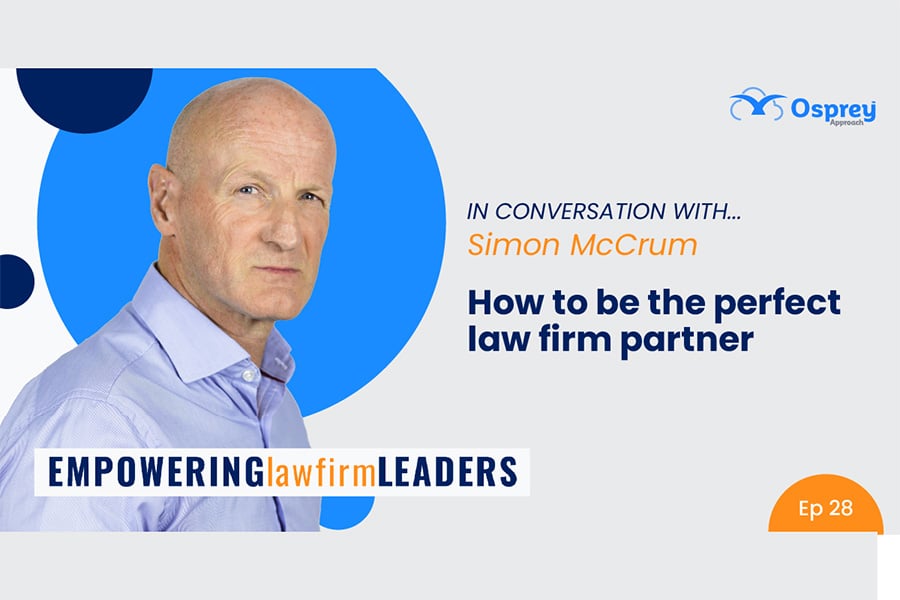

For episode 28 of Osprey Approach’s podcast series, Empowering Law Firm Leaders, Simon McCrum, owner of McCrum Management Consultancy and author of The Perfect Partner, discusses the qualities that define a successful law firm partner; how to run more effective partner meetings; and why building trust, developing future leaders and creating a shared vision are essential to long-term success.
Drawing on his experience as a former managing partner of one of the UK’s fastest-growing law firms, Simon shared practical insights into how partners can strengthen firm culture, improve commercial performance, and create an environment where people and businesses can thrive.
Three things every law firm partner should know#
1.Trust is the foundation of leadership
Being a good partner starts with being a good human. Simon believes influence comes from earning the confidence of colleagues through consistent behaviour, keeping promises, and making people feel valued.
2. Successful partnerships need clear direction
Effective partner meetings should focus on agreed priorities, not open discussions. Simon advocates creating shared ‘rails’ that guide decisions around people, clients, finances, and compliance.
3. Developing people is a leadership responsibility
Appraisals, mentoring, and time spent with junior colleagues are essential to building future leaders. Partners must actively support talent if they want people to grow and remain within the firm.
What makes a good law firm partner?
For Simon, the answer is surprisingly straightforward. “If I were to give a short answer to your question, what makes a good partner? The answer is: a good human. That’s the beginning.”
He believes trust is the currency of influence. “Partners are the influencers… How do you become an influencer? The answer is, people have to trust you.”
That trust is built through everyday actions: doing what you promise, treating people fairly, and showing genuine interest in their development. Leadership is not necessarily determined by seniority, either.
“Leadership can arise on the part of a secretary… a partner… can simply fail to attain leadership.”
Simon also stresses that successful firms must recognise the contribution of their business services teams, not just their lawyers. “Try running a law firm without an IT team… You can always find new lawyers. You cannot find a new practice manager or finance director.”
Making partner meetings more productive
Partner meetings are often viewed as an obligation rather than an opportunity to make progress. Simon thinks this is due to firms failing to give them sufficient structure and purpose.
“Most partners dread the forthcoming partners’ meeting… Here we go again,” he says.
His solution is to establish clear priorities before the year begins, involving partners in a structured discussion to agree on what the firm wants to achieve. Responsibility for each priority should then be assigned, allowing meetings to focus on progress and accountability.
Without that preparation, discussions can quickly lose direction. “Give a partner a chance to speak – boom, off you go – and literally, the wheels come off.”
Strong facilitation is therefore essential, ensuring conversations remain focused on the agreed objectives rather than becoming dominated by individual concerns.
Creating the ‘rails’ for long-term success
Simon believes firms need clear principles to guide their decisions and behaviours. He calls these principles ‘rails’, arguing that they should be developed collectively rather than imposed by senior management.
“You can’t impose this stuff on people… Get them to design the rails that we are going to stick on.”
These rails should cover four areas: how a firm treats its people, clients, finances, and approaches compliance and its wider community responsibilities.
Once agreed, they provide a framework for decision-making and help ensure everyone is working towards the same goals.
Importantly, Simon sees these principles as a way of identifying future leaders. “Lawyers you can get anywhere. Leaders, now we’re talking… I am desperately searching all the time for leaders.”
By giving people opportunities to take responsibility and demonstrate leadership, firms can identify talent beyond the partnership and develop the next generation of decision-makers.
Building a culture where people want to stay
Changing an established firm culture takes time, particularly where silos and a ‘my client’ mentality have become embedded.
Simon advocates listening before attempting to introduce change, recognising that behaviours often develop over many years. “Nothing is anyone’s fault… situations have been decades in the making.”
He believes leaders need to spend time understanding colleagues’ concerns and helping them see the benefits of working collaboratively. Providing clear career progression and creating an environment where people feel valued can also reduce the instinct to protect individual client relationships.
Appraisals are another important part of this process. Simon is critical of partners who repeatedly postpone them because of competing priorities.
“I can’t tell you… the number of partners I’ve met who just haven’t been able to get round to appraisals… because basically, I’m just too busy.”
For Simon, face-to-face appraisals demonstrate that individuals matter. They also provide an opportunity to give honest feedback, recognise potential, and help people understand how they can progress.
Developing the next generation of leaders
As technology and AI increasingly influence legal work, Simon believes firms must place greater emphasis on emotional intelligence and practical experience.
“There’s plenty of lawyers sat giving advice… using ChatGPT to work out what the advice should be.”
However, he warns that technology cannot replace the judgement and understanding developed through working alongside experienced colleagues. “You were dismantled. And rebuilt. That made for great lawyers.”
With hybrid working changing how teams interact, partners need to make a conscious effort to spend time mentoring and supporting junior lawyers. “Half an hour at the end of the day… is just part of life… Partners have got to find more time to make people great.”
Without that investment, firms risk developing technically capable lawyers who lack the experience and confidence to make sound decisions independently.
The mindset that makes the perfect partner
For Simon, being the perfect partner is not about status or technical ability alone. It is about earning trust, providing direction, and taking responsibility for the people and businesses around you.
From creating productive partner meetings to establishing shared principles and investing in future leaders, successful partnerships require consistent effort and a willingness to put the wider firm first.
Ultimately, partners set the tone. Those who lead with humanity, commercial awareness and emotional intelligence will be better placed to build resilient businesses where people feel valued, clients receive an excellent service, and future leaders can flourish.
Watch the full interview with Simon McCrum now to discover more advice and guidance on becoming the perfect law firm partner. You’ll also hear Simon’s insights on business development, getting the most from existing client relationships and the qualities that distinguish a leader from a manager.
This article was submitted by Osprey Approach as part of an advertising agreement with Today’s Family Lawyer. The views expressed in this article are those of the advertiser and not those of Today’s Family Lawyer.