The latest Quarterly Family Court Statistics paint a “stark picture of our justice system”, Law Society vice president Brett Dixon said, in response to figures which show an increase in the number of new family court cases and a rise in the number of unrepresented litigants.
In the three months from January to March 2026 there were 71,259 new cases in family courts, up 3% on the same quarter in 2025, driven by increases in private law (16%), financial remedy (11%), public law (5%) and domestic violence (4%) cases. The figures also reveal a decrease in adoption (7%) and matrimonial matters (5%).
The statistics also show increases in both domestic violence remedy orders applied for and orders made. The number of domestic violence remedy orders applied for was 9,322, up 5% compared to the equivalent quarter in 2025, while the number of orders made also increased by 5% over the same period, to 9,867.
With the FIFA World Cup currently underway, the Crown Prosecution Service has warned of a rise in domestic abuse after research found that on match days the risk rose by 26% when the English national team won or drew, and rose by 38% when the national team lost.
In total open private family cases, the first quarter of the year saw an increase of 11%, to 40,971, compared with the same period last year.
Applications under the no-fault divorce legislation fell 5% in Q1 2026 compared with Q1 2025, with 28,632 applications. Of those, 72% were from sole applicants and 28% from joint applicants. The average time from the date of application to conditional order was 39 weeks, down three weeks from the same period in 2025. The average time from application to final order was 67 weeks, down seven weeks from the equivalent quarter in 2025.
Financial remedy applications were up 11% compared with the same quarter last year, to 12,646. There were 12,764 financial remedy disposal events, up 12% compared with a year earlier. During the latest quarter, 73% of applications were uncontested and 27% were contested.
There were 4,160 public law cases started in January to March 2026, up 5% compared to the equivalent quarter in 2025. Cases disposed were down 5% to 3,766.
Individual children involved in new public law applications rose by 8% to 7,205 in January to March compared to the same quarter last year, while the number of orders applied for increased by 9%. In January to March 2026, care orders made up 65% of public law orders applied for (3,197).
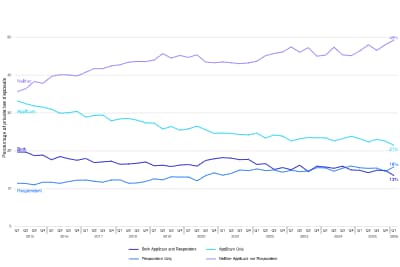
The continued upward trajectory of unrepresented parties continues, with nearly half of private law disposals having no representation for the applicant or respondent – up three percentage points from January to March 2025. The proportion of cases where both parties had legal representation was 13% in January to March 2026, down one percentage point compared to the same period in 2025.
Law Society of England and Wales vice president Brett Dixon, said: “These figures paint a stark picture of our justice system. Years of government underfunding are still leaving far too many people struggling to secure safety and stability for themselves and their families through the courts. While some changes are beginning to help, such as increased sitting days, the government still needs to take urgent cross-system action to tackle backlogs and delays.
“While we welcome a timelier resolution in public cases in the family courts, the number of public and private cases continue to rise. These cases regularly handle domestic abuse allegations, yet often one party will not have access to legal representation. This is why we continue to campaign to secure the future of family legal aid to ensure that domestic abuse victims and their children are protected.
“Access to justice should be available to everyone. Restoring legal aid is essential to achieve that.”