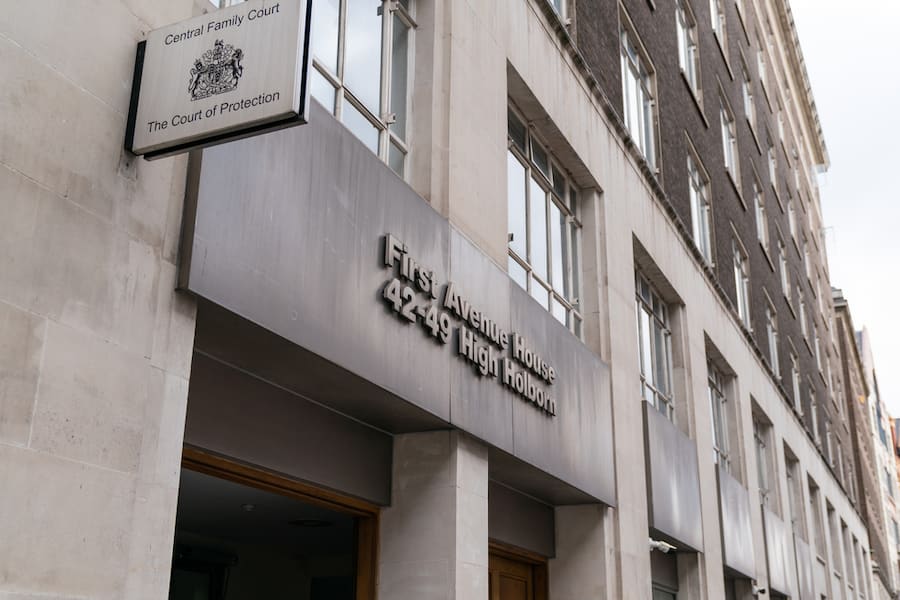

The first Court of Appeal judgment considered under the Child Focused Court (CFC) model has dismissed the majority of an appeal made by a mother against child access arrangements with a father who had admitted domestic abuse.
In a judgment on Re C (Child Arrangements Orders; Domestic Abuse; Child Focused Court) [2026] handed down on 29 September 2026, the president of the Family Division stressed that the CFC model “has not altered the substantive legal framework” of the family court.
In April 2026, a Wrexham family court judge ordered that the four children, with ages ranging from six to 14, should live with their mother and have limited supervised direct contact with their father. The mother’s bids to prevent any direct contact between the father and the children, to restrict the father’s parental responsibility, and to make a non-molestation order were refused.
The Wrexham judge also made an order under section 91(14) of the Children Act 1989 restricting both parents from making further applications without the court’s permission for a period of one year.
The Court of Appeal dismissed the mother’s appeal against the contact arrangements and other welfare decisions. It did, however, allow the appeal in regard to the section 91(14) order made against the mother.
In his judgment, Sir Stephen Cobb, president of the Family Division, said: “Every day, judges and magistrates in the Family Court are called upon to make important decisions about the future care and upbringing of children whose lives and family relationships have been shaped, and sometimes deeply scarred, by domestic abuse. These are never easy cases.
“This appeal has raised questions about how the responsibility vested in judges and magistrates should be discharged in cases which come before the court for determination under the new procedure for determining child arrangements for separated families known as the ‘Child Focused Court’ (‘CFC’) model.”
The Appeal judges concluded that the Family Court judge had been fully aware of the father’s admitted history of serious domestic abuse and had “carefully considered” the requirements of Practice Direction 12J FPR 2010 principles, which governs cases involving domestic abuse, and that the judge concluded that limited supervised contact was in the children’s best interests.
Child Focused Courts – previously known as Pathfinder courts – were rolled out across England and Wales earlier this year, with £17m in government funding. The aim of the model is to put the welfare of children first, using a more investigative approach, encouraging multi-agency collaboration, with earlier information gathering, rather than through multiple hearings.
The judgment stressed that the introduction of the CFC model has changed procedure and culture, but has not changed the “substantive” law, that the “welfare of the child remains paramount” and that “the obligations imposed on the Family Court where domestic abuse is alleged or established are unchanged”.
Sir Cobb said the original judge “adequately explained his reasoning over a number of paragraphs, and cannot be said to have been wrong in his conclusions”.
He said: “I am satisfied that when the Judge reached the decision now under appeal he had firmly in mind the damaging effect of the father’s behaviour which had been a central feature of the proceedings which concluded in 2024; the judge had described the earlier admissions of domestic abuse as being at the ‘heart’ of the case.”
He added: “The father’s conduct was, in my judgment, sufficiently well understood by the judge to enable him to address the relevant risks within the framework of his order. His approach was entirely consistent with the ‘Guidance for Judges and Magistrates: Fact-Finding Hearings and Domestic Abuse in Private Law Children Proceedings’.”