
The latest episode of Osprey Approach’s Empowering Law Firm Leaders podcast explores how law firms can embrace artificial intelligence without losing the human qualities that make legal advice valuable, or compromising the development and wellbeing of their people.
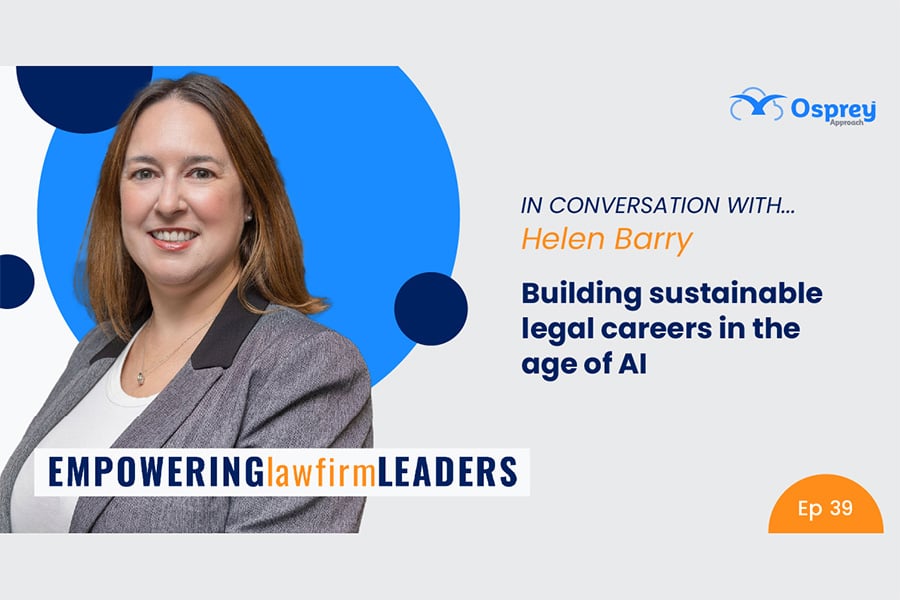
In episode 39, Helen Barry, director and head of property at Watkins & Gunn Solicitors, shares her practical perspective on building sustainable legal careers in an increasingly technology-driven profession. Drawing on more than 15 years of experience, Helen discusses alternative qualification routes, developing junior lawyers, the practical benefits of AI and creating an environment where people can thrive at every stage of their career.
This latest conversation covers:
- Why alternative qualification routes deserve greater recognition
- What makes a legal career sustainable, and the responsibility firms have to their people
- How to develop junior lawyers as AI changes traditional learning opportunities
- Where AI and automation can deliver practical benefits in conveyancing
- Why technology must enhance, rather than replace, the human touch
Helen emphasises that success should not come at the expense of people’s health, confidence or personal responsibilities. “Lawyers are humans, not robots.” She believes firms need to provide good supervision, realistic expectations, proper training and honest conversations about the changing role of technology, while recognising that not everyone aspires to partnership and that different career ambitions deserve to be valued.
As AI changes the tasks traditionally undertaken by junior lawyers, Helen believes firms must rethink how people develop their legal skills. Training needs to focus on legal reasoning, risk spotting, client impact and professional judgment, rather than relying on learning by observation. “It’s really important to teach them how to use it critically.” Junior lawyers must learn to question, challenge and improve AI-generated work, developing the skills that technology cannot replace.
However, Helen stresses that efficiency must not come at the expense of sound legal judgment or personal accountability. Clients often seek legal advice during stressful and significant moments in their lives, when they need clarity, reassurance and someone they can trust. “Technology helps with delivery, but it doesn’t replace the empathy, or the nuance, or the contextual judgment, or ultimately the professional responsibility.”
Ultimately, Helen believes the profession should view technology as an opportunity to improve legal services while preserving what makes them valuable. “It’s not choosing between efficiency and the human touch. It’s making sure technology enhances the service without stripping out the human qualities that make legal advice really valuable – and that’s what you’re paying for.”
Watch the full interview with Helen Barry now to discover more about building sustainable legal careers, embracing AI thoughtfully, developing the next generation of lawyers and leading high-performing conveyancing teams. You’ll also hear Helen’s candid views on the future of the conveyancing role and her advice for the next generation of law firm leaders.
This article was submitted by Osprey Approach as part of an advertising agreement with Today’s Family Lawyer. The views expressed in this article are those of the advertiser and not those of Today’s Family Lawyer.