
The Law Society of England and Wales is calling for Prime Minister Andy Burnham to implement the means test reforms to legal aid promised by earlier governments.
A 2018 report, Priced Out of Justice, commissioned by the Law Society found the means test had become disconnected from the real cost of living leaving many people, including those living below the poverty line, unable to claim legal aid because the means test hasn’t been updated since 2009, despite substantial inflation. The Law Society said it is particularly concerned about the lack of access to legal aid in private family proceedings, with the number of people representing themselves in the family courts having more than tripled between 2013 and 2026.
Meanwhile, referrals to legal aid mediation for family disputes have dropped by 61%.
Currently, only individuals living in deep poverty, up to 80% below the minimum income standard, will be eligible for full legal aid. The proportion of the population eligible for legal aid fell from approximately 50% of the population in 2000 to around 19% in 2022. This is despite legal aid fees having not increased since 1996, and having been cut by 10% in 2011.
The Law Society is calling for the implementation of the means test reforms promised by earlier governments, but also the regular uprating of financial eligibility thresholds in line with inflation, so that access to legal aid does not steadily erode again. The professional members’ body for solicitors also wants the government to impose Protecting Universal Credit passporting arrangements, especially for victims of domestic abuse. The Society wants the government to go further than adjusting the means-test for abuse survivors, by imposing non-means-tested legal aid for protective injunctions and improved access for survivors whose circumstances are distorted by economic abuse or trapped capital.
Research found that many domestic abuse survivors struggle to satisfy financial eligibility requirements despite lacking realistic access to financial resources. Economic abuse can mean income or assets exist on paper but are controlled by an abusive partner. This can leave survivors self-representing in family proceedings, taking on debt to fund representation; or remaining in abusive situations because they cannot afford legal costs.
Another key concern is individuals who technically own a share of a property but cannot access that value because of ongoing family proceedings or abuse.
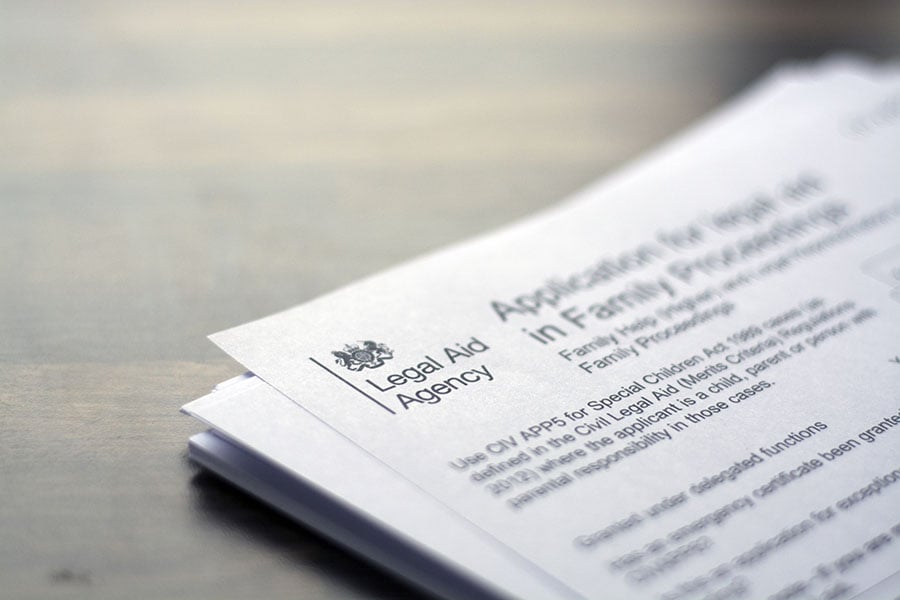
The government consulted on changes to the means test in 2022 and committed to improvements in 2023. It then said it would delay implementation of the changes until 2026 due to problems with the Legal Aid Agency IT system. However, there have been no further announcements from the government.
The Law Society also says access to legal aid is also essential to achieving the government’s Violence Against Women and Girls (VAWG) objectives, but it is presently omitted from its VAWG strategy.
Today’s Family Lawyer has reached out to the Ministry of Justice for comment but a reply hadn’t been received by press time.