
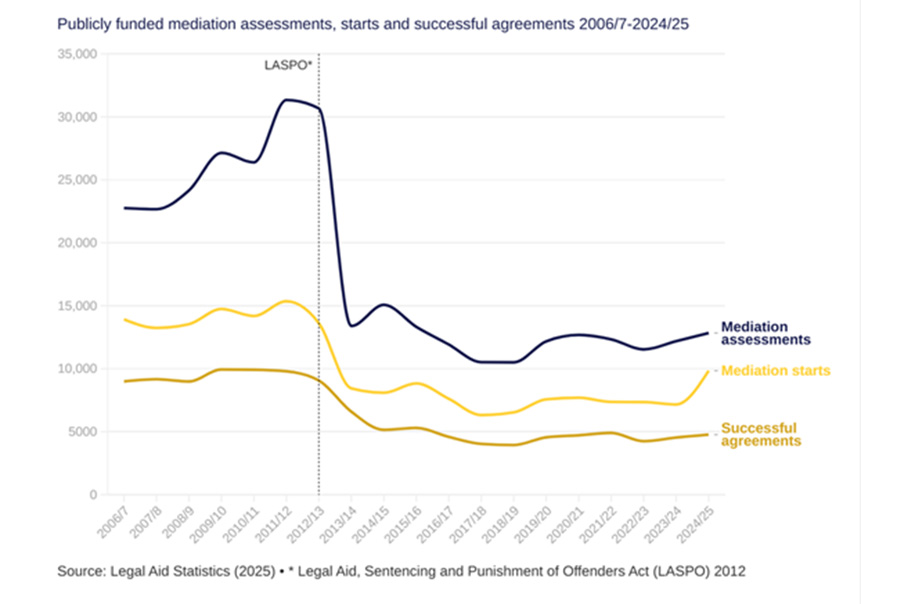

Publicly funded mediation has seen a substantial decline since 2013, with a 60% drop in assessments over 12 years and a halving of successful agreements, data from Nuffield Family Justice Observatory reveals.
The fall is frequently attributed to the removal of legal aid for most private law cases, as families were most often signposted to mediation through their lawyers, the organisation said.
“Following the Legal Aid, Sentencing and Punishment of Offenders Act (LASPO) the number of families starting mediation has remained low, however a small uptick in assessments in 2024/25 may indicate some change in this area.”
Initiatives such as the introduction of a voucher scheme in 2021 which offers up to £500 per family towards mediation costs, have not been properly tracked to establish whether they are effectively diverting families from court, Nuffield added.
Mediation is not appropriate for all families and particularly may not be for families who have experienced domestic abuse, Nuffield points out.
Recent research by the Domestic Abuse Commissioner found that 87% of closed case files, and 73% of observed private law cases feature domestic abuse, indicating that a large proportion of families could be exempt from mediation.
Between April 2019 and March 2024, only 35% of private law applicants attended a mediation information assessment meeting, as a large proportion claimed exemptions (NAO, 2025).
“The decline in publicly funded mediation raises wider questions about how well families have access to appropriate guidance and support in the family courts, not just through mediation, but legal representation or otherwise,” Nuffield said.
“Efforts to divert families from court, or improve families’ experiences of feeling heard during proceedings, risk being undermined if early, adequately resourced forms of advice and assistance are not accessible.”
Nuffield Family Justice Observatory data tracker: publicly funded mediation

















One Response
The decline in publicly funded mediation is inseparable from the impact of LASPO and long-term underfunding of the sector. Since legal aid was removed from most private family cases in 2013, the main referral pathway into mediation — solicitors — was largely lost. At the same time, Legal Aid mediation fees have not increased for over 28 years. Expecting mediation to absorb growing pressure from the courts without meaningful investment is unrealistic.
Many families also never reach mediation at all, as they are exempted at solicitor level and move straight into litigation, which contributes to court congestion. Mediation is not driven by profit or adversarial incentives; it is a neutral process that depends on both participants choosing a non-litigious route. If early resolution is genuinely the goal, the system must ensure families are properly supported and that mediation is resourced to function as the alternative it is intended to be.