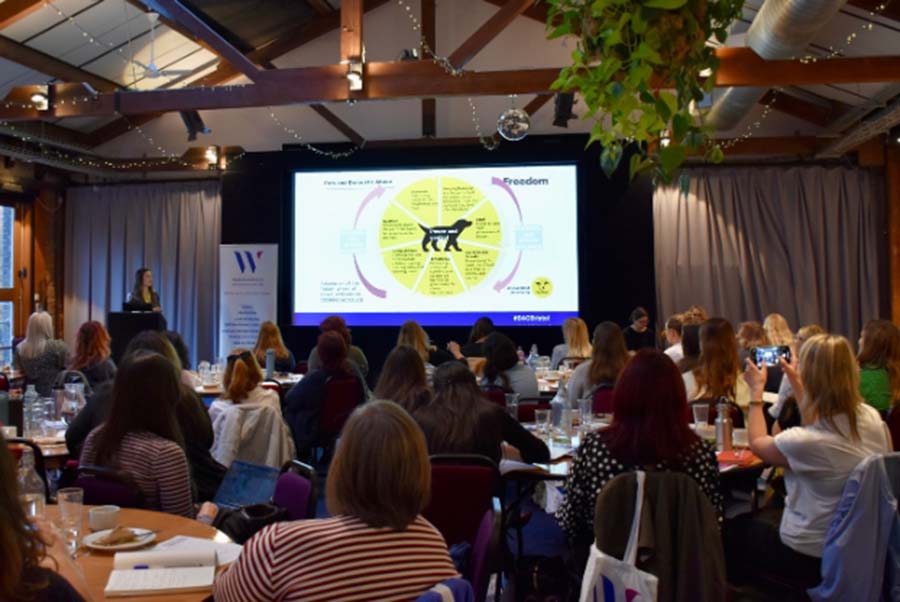

The fourth annual Domestic Abuse Conference Bristol brought together almost 100 professionals and frontline workers from across England and Wales to share learning, strengthen partnerships and promote survivor-centred practice.
The not-for-profit conference, founded and organised by Watkins Solicitors, is a key multi-agency event addressing domestic abuse in the South West. This year’s programme brought together guests with lived experience and experts in practice and research to strengthen understanding and improve support for survivors.
Beverley Watkins, managing partner at Watkins Solicitors, opened the conference with a legal update covering the latest developments in domestic abuse and family law. Her talk addressed the government’s announcement to end the presumption of parental contact where it risks harm, the Cafcass Domestic Abuse Practice Policy (implemented in January 2025), and recent case law on non-molestation orders.
Beverley also discussed new restrictions on parental responsibility for convicted offenders, the Domestic Abuse Commissioner’s 2025 report Everyday Business, and the Pathfinder pilot scheme for children matters. She highlighted how the language professionals use can make a real difference to survivors’ experiences in the family courts, ensuring that every decision keeps safety and children’s welfare at the centre.
Gareth Jones, survivor and ambassador, shared his lived experience as a male survivor of domestic abuse. His experience illustrated how coercive control can extend far beyond physical violence, from being denied access to food and hygiene to having his contact with family tightly monitored.
Gareth reflected on the psychological impact of abuse and the vital role that professionals can play in changing a survivor’s journey, describing moments where an act of empathy or informed intervention might have altered the course of his recovery and demonstrating the importance of early recognition and trauma-aware responses.
Now an ambassador for the Employers’ Initiative on Domestic Abuse (EIDA), Gareth’s message to attendees was that signposting, listening without judgement, and knowing where to refer can make a critical difference to safety and recovery.
Kate Worthington, senior practitioner at the Revenge Porn Helpline, delivered an impactful session on image-based abuse and technology-facilitated coercive control, highlighting how digital forms of abuse are increasingly intertwined with domestic abuse. Drawing on cases from the helpline’s national caseload, she explained how perpetrators use technology to monitor, threaten, humiliate and isolate victims, behaviour that can continue after relationships have ended.
Kate outlined the legal framework covering these offences under the Voyeurism (Offences) Act 2019 and the Online Safety Act 2023 and provided practical guidance for professionals on how to help victims remove harmful content and report abuse safely. She also emphasised the importance of joined-up, trauma-informed responses across agencies, noting how online abuse an prolong fear and control in ways that mirror physical and emotional harm.
Natasha Saunders, campaigner, consultant and public speaker at Survive. Rise. Thrive., shared her eight-year experience of multifaceted abuse including sexual, physical, emotional, economic and technological abuse, alongside coercive control.
Her account exposed the ways in which coercive control infiltrates every part of a survivor’s life: from access to food and finances, to communication, autonomy and personal identity. Drawing on her lived experience, Natasha reflected on what would have made a difference – awareness, empathy and accountability – and how every professional interaction, however brief, has the potential either to harm or to heal.
Harriet Smailes, research manager at the Institute for Addressing Strangulation, delivered a clinically focused session on non-fatal strangulation and its risks. Drawing on research findings and case examples, she explained how strangulation can be missed or underestimated because there may be no visible external injuries.
Her session guided attendees through the practical steps that frontline professionals, police, advocates and legal practitioners should take when strangulation is suspected, including how to record key details, what symptoms require immediate escalation, and how to support a survivor through referral pathways.
Cassie Summers, team leader at Dogs Trust Freedom, concluded with a session on the link between domestic abuse and pet ownership. Using data and case experiences from the Freedom Programme, she explained how perpetrators can use pets as tools of coercion and control, including threats, harm, neglect and the withholding of access, all of which can prevent survivors from leaving abusive situations.
She also highlighted the emotional significance of companion animals in recovery, explaining how fear for a pet’s welfare is one of the most frequently cited reasons for delayed escape.
Commenting on the event, Beverley Watkins said:
“Our conference is about practical collaboration. Domestic abuse affects every community, and improving outcomes for survivors means listening to lived experience, sharing professional expertise and building stronger pathways between organisations. We are proud to play our part in bringing people together to make that happen.”
The next Domestic Abuse Conference Bristol will take place on Thursday 12th November 2026 at The Mount Without in Bristol.