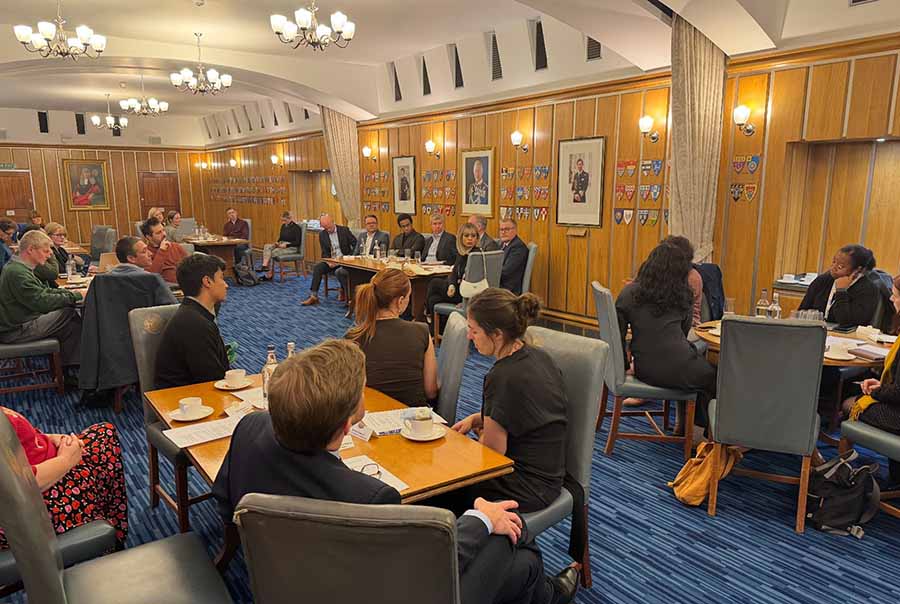

Judges and representatives from children’s and young people’s services came together to discuss reducing the number of care leavers in the criminal justice system last week, at an event hosted by the City of London’s sheriffs.
The session at the Old Bailey, led by sheriffs Keith Bottomley and Robert Hughes-Penney, explored how courts and agencies can work together to reduce the unnecessarily criminalisation of care-experienced young people.
Discussions focused on the Pan-London Compact for Care Leavers, a cross-sector agreement designed to ensure care-experienced young people receive better support when they come into contact with the justice system. Participants also addressed identification and information sharing, prevention and diversion, and better support for care leavers who enter the criminal justice system.
‘The law must be applied with fairness and understanding’, said Bottomley, who also chairs Partnership for Young London, the capital’s regional youth unit.
“This wide-ranging discussion was aimed at understanding how the unique circumstances of care-experienced young people should be recognised to help prevent unnecessary criminalisation.”
The agenda featured contributions from the Pan London Children in Care Council and the West Midlands protocol, a regional agreement in which agencies work together to divert care-experienced young people away from the justice system.
The Mayor’s Office for Policing and Crime (MOPAC) were also present to discuss the recently launched MOPAC protocol, which sets out practical steps for police, social workers and carers to prevent unnecessary criminalisation. The protocol promotes a ‘child-first’ approach, prioritising prevention, early identification, diversion from prosecution and trauma-informed support.
The MOPAC protocol will link to wider reforms, including the Children’s Wellbeing and Schools Bill, currently before Parliament, which will extend corporate parenting duties to all government departments.
Chair of the City of London Corporation’s Community and Children’s Services Committee Helen Fentimen said:
“Care-experienced young people often face barriers that others do not. Reducing criminalisation is about giving them a fair chance to succeed and ensuring the system supports, rather than punishes, vulnerability.”
A working group co-ordinated by the London Innovation and Improvement Alliance, also represented at the session, will co-ordinate the efforts of the partners to work with young people and provide better and more targeted support.